Blog · 2 November 2026
From the 1913 crossword to Wordle: a short history of the daily puzzle
Newspapers didn’t invent the daily puzzle because they thought it was good for us. They had a page to fill every morning. What’s interesting is that, more than a hundred years later, the most successful puzzle on the internet chose to work exactly the same way, even though nothing forced it to.
1913: a diamond-shaped grid in New York
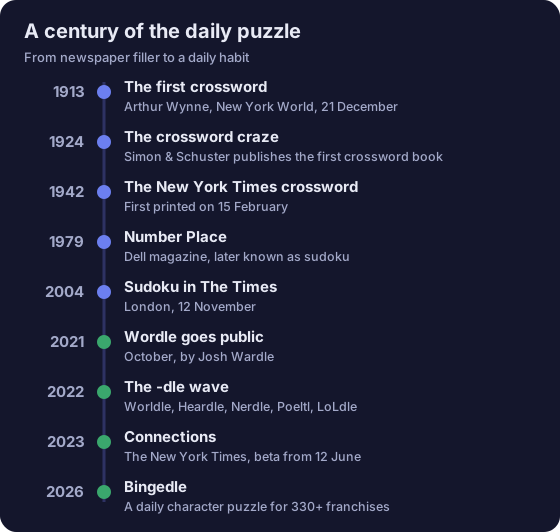
On 21 December 1913, the New York World ran a puzzle by Arthur Wynne, a journalist born in Liverpool, in its Sunday “Fun” section. He called it a “word-cross”. It was shaped like a diamond and had no black squares inside it, so it doesn’t look much like a modern crossword, but every idea was there: numbered clues, answers that cross, and a grid you could finish over a cup of coffee. An illustrator later flipped the name round to “cross-word”, and it stuck.
It took about ten years to become a craze. In 1924 a new publishing house, Simon & Schuster, put out the first book of crosswords, apparently on the suggestion of co-founder Richard Simon’s aunt. The publishers were nervous enough to print a small run. It came with a pencil attached and sold out, and the crossword became a national obsession.
The New York Times held out until 15 February 1942. Part of the reasoning was the war: a puzzle on a Sunday gave readers a few minutes away from the news. That idea, a small contained problem you can actually solve while bigger ones go on around you, comes up again and again in this story.
1979 to 2005: the number puzzle that went the long way round
Sudoku has an odd history for something that feels so obvious. The modern version first appeared in 1979 in a Dell puzzle magazine in the United States, under the name Number Place, and was most likely designed by Howard Garns, a retired architect from Indiana. In America it stayed a fairly quiet magazine puzzle.
In 1984 the Japanese puzzle company Nikoli picked it up, and its president, Maki Kaji, gave it the name that later became “sudoku”. It was a hit in Japan for years before anyone in the English-speaking world noticed. Then Wayne Gould, a New Zealander who had just retired as a judge in Hong Kong, saw a puzzle book in a Tokyo bookshop in 1997 and spent six years writing software to generate puzzles and grade their difficulty. The Times of London started printing them on 12 November 2004.
By the summer of 2005 Britain was hooked. The Times was running an easy and a hard puzzle side by side, Sky One aired a live sudoku television show, and by mid-2006 almost every major American newspaper printed one a day. It’s a good example of something that would happen again with Wordle: a format that had existed for years suddenly took off once it was easy to share and talk about.
2021: one word a day, on purpose
Josh Wardle first prototyped his word game in 2013, set it aside, and came back to it during the pandemic. When it went public in October 2021, it did something unusual for a web game. It refused to give you more. One puzzle, and then a countdown to tomorrow’s.
According to The New York Times, Wardle felt that a single daily puzzle left people wanting more, and it kept the game to about three minutes of your day. He told reporters he wasn’t trying to do anything shady with players’ data or attention. It was just a game. The limit wasn’t a technical one. A website can serve a thousand puzzles as easily as one. It was a choice, and it turned out to be the most important design decision in the game.
The numbers that followed are hard to picture. Wordle had about 90 players on 1 November 2021 and more than 300,000 by 2 January 2022. The Times bought it on 31 January. In 2023 it was played 4.8 billion times, and in 2024 the paper reported more than 11 billion puzzles solved across its games in a single year.
2022 to now: everyone gets a puzzle
What happened next is the part we’re part of. Wordle’s format was simple enough to copy and flexible enough to bend. Worldle used country outlines, Heardle used song intros, Nerdle used sums, and character games like LoLdle used rows of facts about a person. The New York Times kept adding its own daily games too. Connections, where you sort sixteen words into four groups, entered beta on 12 June 2023 with puzzles written by Wyna Liu, and it quickly became one of the paper’s most talked-about games.
There are now directories listing more than a thousand daily games, covering everything from geography to football to anime. Bingedle started in October 2026 with the idea of giving every show, film series and game its own one: one character a day, the same for everyone, solved in a few minutes and shared without spoilers.
Why the format keeps winning
Look at the three big moments here and they have the same shape. A puzzle that fits in a short gap in your day. A fixed supply, so it never turns into a chore. And something to talk about with other people who did the same puzzle. In 1913 the shared part was the newspaper on the kitchen table. In 2005 it was the commuter next to you on the train with the same page open. In 2022 it was a grid of green and yellow squares in a group chat.
The technology changed every time. The appeal didn’t.
Sources
- Wikipedia, Crossword: Arthur Wynne, the 1924 Simon & Schuster book and the New York Times crossword of 1942.
- Guinness World Records, First crossword puzzle.
- Wikipedia, Sudoku: Howard Garns, Nikoli, Wayne Gould and the 2005 boom.
- Wikipedia, Wordle: history, player numbers and plays per year, citing The New York Times, The Guardian and the BBC.
- AOL, the Wordle puzzle that ended 5.6 million streaks in 2024, for the 2024 total of puzzles solved.
- Wikipedia, The New York Times Connections.
- dles.gg, a directory of daily games.