Blog · 2 November 2026
What dle games are, and why people keep coming back to them
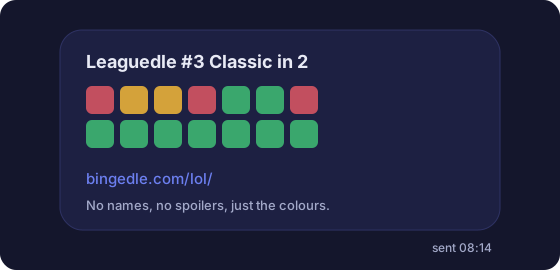
Somebody in a group chat posts five rows of coloured squares and a number. Nobody asks what it means. Half the chat already played that morning, and the other half goes and does it now so they can post their own. That little ritual is the whole genre in one scene, and it started with a word game a software engineer made for his partner.
Where the name comes from
Josh Wardle built Wordle for Palak Shah, who loved word games, and the name is a pun on his own surname. Shah went through the roughly 13,000 five-letter words in English and kept about 2,000 she thought people would know. The game went public in October 2021. On 1 November it had around 90 players. By 2 January 2022 it had more than 300,000, and on 31 January The New York Times bought it for a price reported to be in the low seven figures.
The detail people forget is the sharing. Wardle noticed a group of players in New Zealand posting their results as little grids of emoji squares, and he built that into the game. Those grids gave away nothing about the answer, so you could post them anywhere, and they spread across social media in late December 2021. The squares did more for Wordle than any advert could have.
Within weeks, other people were borrowing the format and the suffix. Worldle, from French developer Antoine Teuf, asked you to name a country from its outline. Heardle played the first second of a song and gave you a little more with every miss; Spotify bought it in July 2022 and closed it the following year. Nerdle swapped words for sums. Framed showed one frame of a film at a time. And games like Poeltl, for basketball players, and later LoLdle took the idea somewhere new: instead of letters, you guessed a person, and every guess came back with a row of facts about how close you were. Directories that track these games now list more than a thousand of them.
So what counts as a dle
There’s no official rule, but the ones that stick share four things.
- One puzzle a day, the same for everyone. You can’t binge it. Tomorrow’s puzzle doesn’t exist yet.
- Every guess teaches you something. You aren’t just told yes or no. You’re told how close you were, and the next guess gets better because of it.
- It’s short. Most rounds take a few minutes, often less.
- The result can be shared without spoiling it. Colours and numbers, never the answer.
Character dles like the ones on Bingedle follow the LoLdle version of point 2. You type a name, and the row that comes back compares your guess with the hidden character across a handful of clues. Here’s a real one from Leaguedle, where a player guessed Irelia on the day the answer was Sett.
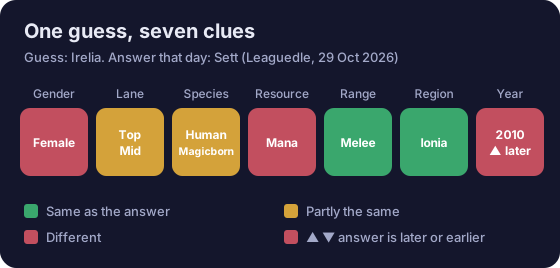
Green means you match. Yellow means you partly match, like sharing one lane out of two. Red means no match, and the arrow on the release year says the answer came out later. Seven tiles, and you already know you’re looking for a male melee champion from Ionia who doesn’t use mana. If you know the game, that’s about five names. If you really know it, it’s one.
Why it works on people
Matt Baldwin, a psychologist at the University of Florida, gave six reasons in an interview with Futurity early in 2022, and they still hold up. The short version:
- The click when you solve it. That small moment where the answer falls into place feels good, even on a bad day.
- The difficulty is about right. Hard enough to need a bit of thought, easy enough that most people finish. That balance is what psychologists call flow.
- Once a day keeps it special. Because you only get one, it never gets old the way an endless game can.
- Other people are doing it too. Seeing friends enjoy the same puzzle makes your own enjoyment feel more real.
- It gives a group something to share. A family chat, a team at work, a group of old friends.
- You get to compare. Got it in three while your brother needed six. That’s a small, harmless win.
A communication professor at the University of Washington made a similar point to Inc.: these games stand in for the watercooler conversation a lot of people lost when they started working from home. You don’t need to talk about anything heavy. You just need to talk about today’s puzzle.
There’s one more reason, and it’s specific to fan games. A fan dle is a test you actually want to take. Knowing that Sett is the only champion who runs on Grit, or that Pierce Hawthorne was in the Greendale study group from the first episode, is useless anywhere else. Here it wins you the day.
What our own numbers show
Bingedle opened on 27 October 2026, and its anonymous counter gives a decent picture of how people really play. Over the first six days there were 6,089 “player-days”, meaning one person on one date. On an average player-day, people started 6.3 rounds across 2 games.
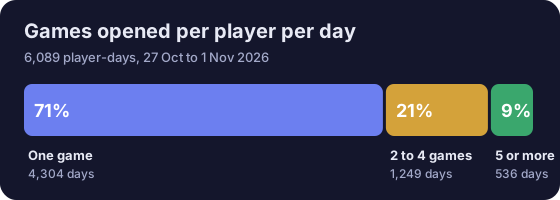
Most people come for one show and play its different modes, like Classic, Quote and Emoji. But about three in ten open a second game the same day, and almost one in ten play five or more. That’s the dle habit stacking up: one puzzle feels too short, so you have another.
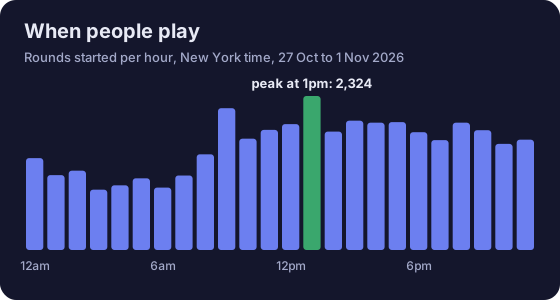
The time of day says something too. Play falls off overnight, picks up through the morning and peaks around 1pm New York time, which looks a lot like a lunch break.
The appeal, plainly
Dle games ask for a few minutes, give you a small win, and hand you something to share that doesn’t spoil anyone else’s morning. They reward you for knowing a thing you already love. And because there’s only one a day, they never wear out their welcome. That’s a rare combination online, where most games are built to keep you playing for as long as possible. A dle is happy to see you tomorrow.
If you want to try a few, start with the one you know best. Parksdle is one of the busiest games on the site and one of the friendliest, Pokemondle is one of the hardest, and Leaguedle is our take on the LoLdle format.
Sources
- Wikipedia, Wordle: history, player numbers, the emoji grid and the New York Times purchase.
- Wikipedia, Worldle and Heardle; the Wordle article also covers Poeltl and other early spin-offs.
- Futurity, 6 psychological reasons everybody is loving Wordle, with Matt Baldwin, University of Florida (January 2022).
- Inc., Why Is Everyone Suddenly Playing Wordle.
- CNBC, The psychology behind your sudden Wordle obsession.
- dles.gg, a directory of daily games, for the size of the genre.
- Bingedle’s own anonymous play counter, 27 October to 1 November 2026.
Play: Leaguedle · Parksdle · Pokemondle