Blog · 2 November 2026
What half a billion Wordles, and our own first week, say about how people play
At the end of 2023, The New York Times looked at 515 million Wordle games played over twelve months and compared what people actually did with what its WordleBot would have done. We read it with a lot of nodding, because a week of running Bingedle had already shown us some of the same habits on a much smaller scale. People are not solving machines. They play the way people do everything else: with favourites, routines and the odd bad day.
Habit one: we open with the guess we like
The most popular first word in Wordle was ADIEU, with AUDIO close behind. Both get four vowels out of the way, which sounds clever. According to the Times, it isn’t. Of the 30 most popular openers, ADIEU did the worst. Players who started with it needed about a third of a turn more than players who started with SLATE, and they failed to solve the puzzle more than twice as often (3.6% of games against 1.7%).
The Times was careful to say this may not be ADIEU’s fault. The kind of player who picks ADIEU might simply be more casual. But the pattern is clear: people choose an opener that feels sensible to them and stick with it.
We see the same thing in character games, just with names instead of words. When we scored every League of Legends champion as a first guess in Leaguedle, the strongest was Irelia, who leaves about two champions possible on average. The fan favourites everyone knows tend to sit lower: Miss Fortune ranks 39th, Jinx 64th. It doesn’t matter much, maybe a guess over a few days. But it’s the ADIEU effect in another costume. The full breakdown is in our Leaguedle opener guide.
Habit two: the day decides the word
The Times found that openers follow the calendar. MERRY on Christmas Eve, PARTY on New Year’s Eve, HEART on Valentine’s Day, GHOST at Halloween, GRAVY and FEAST at Thanksgiving. PARTY even got a small bump every weekend.
Nobody plays a daily puzzle in a vacuum. It sits inside a real day, and people bring the day into it. That’s part of why the shared result matters so much. It isn’t just a score. It’s a little note to friends about how your morning went.
Habit three: we play in the gaps
Wordle’s data doesn’t say when people play, but ours does. On Bingedle, play drops overnight, builds through the morning and peaks at around 1pm New York time.
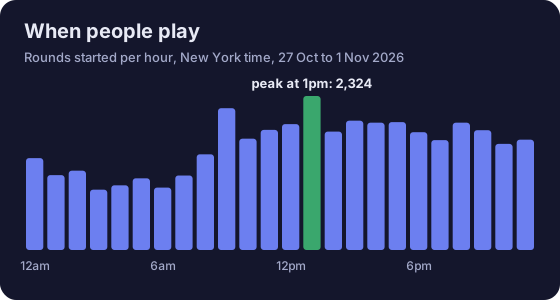
That’s a lunch break. A dle fits neatly into the small pockets of a day: the commute, the queue, the ten minutes before a meeting. It’s the same reason crosswords and sudoku lived in newspapers for a century. They were sized for a coffee.
Habit four: some puzzles just break people
The hardest Wordle of that year was JAZZY, which took 5.82 guesses on average. By solve rate, the worst was JOKER: only 71% of players got it. The Times noticed that the tough ones tended to start with J, end in Y or contain a double letter.
Our toughest game in the first week landed on almost exactly the same number. Brooklyn Nine-Nine has only 27 possible answers, but just 71% of its Classic rounds ended in a solve, the lowest rate on the site. A small cast doesn’t make an easy game. Size and difficulty aren’t the same thing.
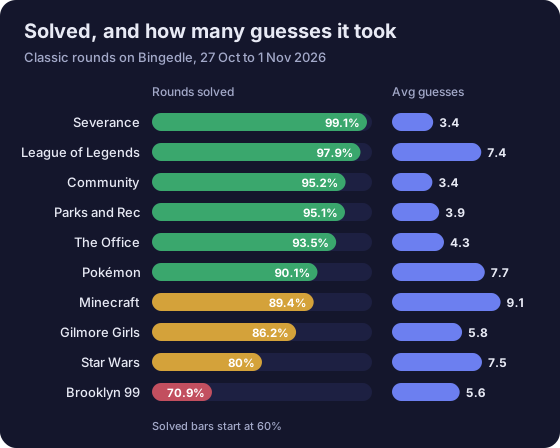
The flip side is just as interesting. League of Legends needed 7.4 guesses on average, one of our slowest games, yet 98% of rounds ended in a solve. Players in that game grind it out. Minecraft took the most guesses of all, 9.1, and almost 90% still finished. When a fanbase cares, people keep going.
Habit five: we want to win, and occasionally we cheat a little
About one Wordle game in every 250 was solved on the very first guess. That’s far more often than luck would allow. The Times listed the innocent reasons first: someone finishing a game on a second device to save a streak, or a friend spoiling it. It also allowed that some people just looked it up.
We don’t publish first-guess numbers, but we did design around this. On Bingedle the answers page never shows the current day’s character, and an answer only appears there once its date has ended everywhere in the world. Streaks matter to people, and they should feel earned.
What we take from all this
The headline from both datasets is that people play daily puzzles as part of their lives, not instead of them. They pick openers that feel right, theme them for the holidays, squeeze them into lunch breaks and care enough about a streak to bend the rules once in a while.
For anyone making these games, that’s a useful reminder. The goal isn’t a perfectly balanced puzzle. It’s a small, fair, finishable thing that fits into someone’s day and gives them something to share. Everything else is detail.
Sources
- The New York Times, The Upshot, “Seven Things We Learned Analyzing 515 Million Wordles”, by Josh Katz and Aatish Bhatia, 17 December 2023 (nytimes.com).
- Bingedle’s anonymous play counter, Classic mode, 27 October to 1 November 2026: 7,404 finished rounds across the 41 games with at least 60 rounds each.
- Our own opener analysis, in the Leaguedle guide.
Play: Leaguedle · Brooklyn99dle · Minecraftdle · Severancedle